
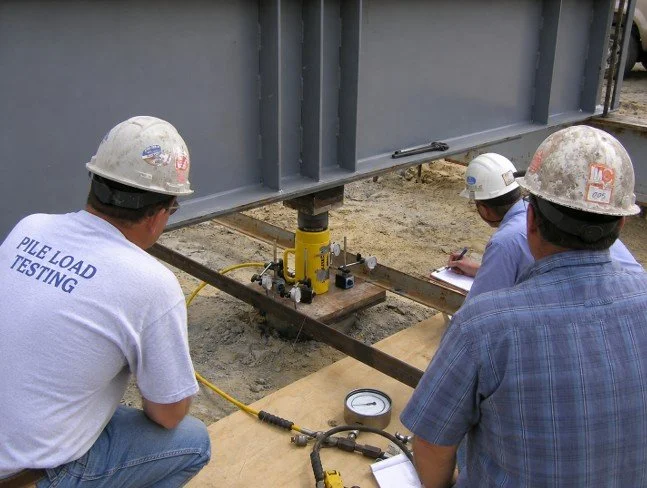
Modern static pile load testing using a hydraulic jack and reaction structure.
Pile testing has been around a lot longer than most people probably realize. The basic goal really hasn’t changed much either.
Put something long into the ground. Make sure it can actually hold what you’re planning to build on top of it. Preferably figure that out before the building decides to test the theory for you.
The methods, on the other hand, have come a very long way.
We’ve gone from basically “drive it until it stops and call it good” to hydraulic jacks, digital gauges, sensors, data logging and computer analysis.
Which, when you think about it, is a pretty impressive amount of technology devoted to answering the question: “Is this going to sink?”
The Really Early Days
People were driving wooden piles into soft ground thousands of years before anyone had a written procedure, engineering standard or safety meeting about it.
Prehistoric lake settlements around the Alpine lakes and places like Ireland used thousands upon thousands of timber piles. Sites such as Robenhausen and Lough Drumkeery have shown carefully pointed oak and birch piles driven several metres into soft ground.
There were no pressure gauges.
No load cells.
No data loggers.
No guy standing there asking if somebody filled out the inspection sheet.
No email chain with 14 people copied asking when the report would be ready.
The basic method was pretty simple: drive the pile until it didn’t want to go any farther and hope you had found something worth building on.
If the house was still standing after winter, excellent news. Engineering success.
If it wasn’t... presumably some lessons were learned.
Herodotus, writing in the 5th century BC, described a Thracian tribe living on houses built high above a lake on piles.
Apparently waterfront property has always been worth making questionable construction decisions for.
Some things really haven't changed.
Then the Romans Got Involved
As usual, the Romans looked at something everyone else was doing and decided to do it on a ridiculous scale.
Vitruvius wrote about driving piles closely together below foundations in soft or wet ground, and noted that buildings in Ravenna were supported this way.
Julius Caesar’s army also built a bridge across the Rhine using driven timber piles — and did it in a matter of days.
Basically the ancient Roman version of:
“Customer needs it by Friday.”
Only instead of overtime, freight problems and six emails asking for an update, they had several thousand soldiers.
And I'm guessing nobody was brave enough to tell Caesar there was an eight-week lead time.
At the Roman circus in Arles, built around the middle of the 2nd century AD, archaeologists found somewhere around 25,000–30,000 wooden piles.
At that kind of scale, there’s a good chance somebody was doing at least some form of proof loading or checking what those piles could handle.
Because even the Romans probably reached a point where “should be fine” stopped feeling like enough reassurance.
The Romans also understood that hammer weight, drop height and how far the pile moved with each blow actually mattered.
Which is fairly impressive considering Excel wouldn’t be invented for another couple thousand years.
No spreadsheets. No calculators. No “please see attached revised version FINAL\_v7.”
Just math and commitment.
Venice: “Yeah, Just Build the Whole City on Them”
Venice might be the best-known example of early pile foundations.
Starting around the 7th and 8th centuries, huge portions of the city were built on millions of short wooden piles driven into lagoon mud.
The Rialto Bridge alone sits on roughly 14,000 piles, while St. Mark’s Basilica is supported by around 10,000.
Which makes complaining about driving twelve piles on a jobsite feel slightly dramatic.
Workers drove the piles using manual methods and simple drop hammers, sometimes working in rhythm and singing while they did it.
They packed the piles closely together, drove them until they wouldn’t go any farther, cut the tops off below the waterline and built over them.
And apparently everybody just carried on with their day.
No engineer standing behind them saying, “Can we just double-check that?”
Amsterdam and other low-lying European cities used similar methods.
The testing procedure was still fairly straightforward:
Pile stops moving? Good.
Building remains upright? Even better.
Simple. Effective.
Also mildly terrifying when you think about an entire city sitting on what is basically a giant underwater game of Jenga.
A very beautiful, extremely expensive game of Jenga.
Eventually Someone Said, “Maybe We Should Actually Test These”
By the 18th century, engineers were starting to recommend something a little more deliberate.
Instead of only driving piles and judging them by how they behaved during installation, they began recommending that piles be loaded afterward and left under load long enough to see what happened.
Which is really the beginning of the modern proof-load idea.
Or, in less technical terms:
“Put a bunch of weight on it and see if it complains.”
Progress.
Turns out waiting until the completed building starts complaining is considerably less convenient.
19th and Early 20th Century: Actual Load Testing
By the late 1800s and early 1900s, properly documented static pile load tests started becoming much more common.
Engineers built reaction structures, stacked heavy materials above piles and eventually used hydraulic jacks to apply controlled loads while measuring settlement.
Documented examples show up on major projects in the United States around 1910–1915, Tokyo in the 1920s and bridges and buildings in Brazil through the 1930s and 1940s.
Some photographs from the 1930s actually look surprisingly similar to pile-testing setups today:
Hydraulic jack.
Reaction structure.
Gauges.
People staring at the whole thing waiting to see if it moves.
Same idea.
Different hats.
Considerably fewer high-vis vests.
At the same time, engineers were also relying heavily on pile-driving formulas — equations using hammer energy and pile penetration to estimate capacity.
They were quick and useful.
They were also estimates.
Basically the engineering equivalent of deciding whether dinner is cooked because “it smells about right.”
Sometimes that works perfectly.
Sometimes you learn something.
And sometimes you're ordering pizza.
Then Things Got Much Smarter
The next major jump came in the 1960s and 1970s.
Researchers at the Case Institute of Technology began measuring the actual stress waves travelling through piles when they were struck by a hammer.
That work eventually led to the Pile Driving Analyzer (PDA) and CAPWAP analysis.
Instead of relying mainly on driving resistance and experience, engineers could now measure what was actually happening inside the pile.
Capacity.
Driving stresses.
Pile integrity.
Energy transfer.
Suddenly there was actual data behind the banging.
Which is usually preferable to just banging on something and hoping you've learned something useful.
Low-strain integrity testing followed, along with methods such as crosshole sonic logging.
Then came better sensors, better computers, automated data collection and increasingly sophisticated analysis.
Pile testing officially entered the modern world.
And naturally, with more technology came more cables.
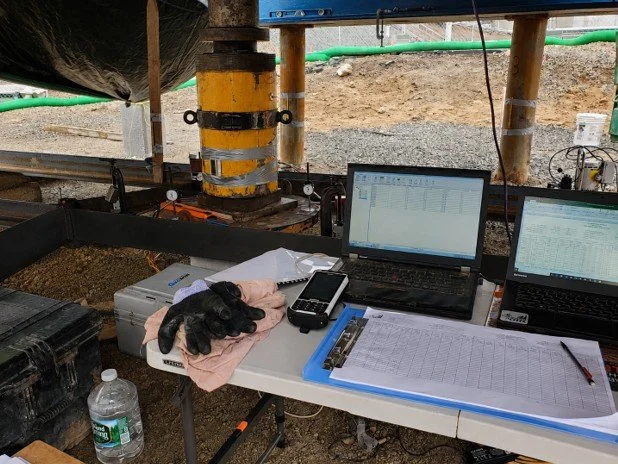
Hydraulic load-test setup with gauges and field instrumentation.
Dynamic testing is extremely useful, but when you need the highest level of confidence in pile capacity, static load testing is still the gold standard.
And static load testing depends heavily on hydraulics.
A high-capacity hydraulic cylinder or jack applies load to the pile in controlled stages.
Instead of smashing the pile with a hammer and measuring its response, you slowly push against it and watch exactly how it behaves.
Much more civilized.
Still involves enormous amounts of force, but civilized.
The jack normally sits between the pile and a reaction system, which might include:
Kentledge weights
Reaction piles
Ground anchors
Structural reaction frames
Pressure is increased gradually and held at specific levels while movement is measured.
Modern systems can use digital gauges, load cells, displacement sensors and data logging to produce detailed load-versus-settlement information.
Which is considerably more useful than someone standing nearby saying, “I don't think it moved much.”
The Romans would understand the basic idea immediately:
Put weight on it and see what happens.
They’d probably just be slightly annoyed that we figured out a way to do it without needing 300 guys and a pile of rocks.
And as we like to say:
You ain’t strong. The oil is.
Different Tests Need Different Hydraulic Tools
There isn’t one magic cylinder that works for every pile-testing job.
Unfortunately.
That would make quoting these things a whole lot easier.
Different applications call for different setups.
General-Purpose Single-Acting Cylinders
These are the everyday workhorses.
They’re well suited to many standard static load-testing applications on commercial, industrial and building foundations.
Reliable, straightforward and not particularly dramatic.
Exactly what you want from a hydraulic cylinder.
Nobody has ever said, “I wish this hydraulic setup had more surprises.”
Low-Profile and Flat Cylinders
When there isn’t much room between the pile and the reaction structure, a standard cylinder may simply be too tall.
Low-profile and flat cylinders provide high force in a much shorter package.
Small but angry.
Like a hydraulic Chihuahua, except actually useful.
High-Tonnage Cylinders
Then you get into the serious stuff.
Large-diameter piles, bridge foundations, heavy infrastructure and other major projects can require enormous test loads — sometimes reaching into the thousands of tons.
This is where high-tonnage hydraulic cylinders come in.
They are basically the hydraulic version of “Okay, enough messing around.”
The kind of equipment that makes a forklift suddenly look adorable.
Double-Acting Cylinders
Double-acting cylinders allow hydraulic power in both directions.
That provides better control during extension and retraction and can be particularly useful when gravity return isn’t practical or controlled unloading is important.
Because sometimes “it'll come back down eventually” isn't really a procedure.
Hollow-Plunger Cylinders
Sometimes a rod, cable, tendon or other component needs to pass directly through the cylinder.
That’s exactly what hollow-plunger cylinders are designed for.
There really is a hydraulic cylinder for almost every strangely specific problem somebody manages to create.
And if there isn't one, somebody will probably call and ask us for it anyway.
And of Course, the Cylinder Is Only Part of It
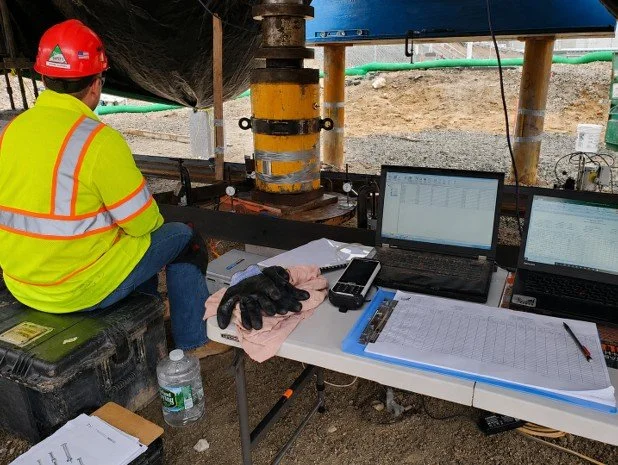
Field data acquisition and instrumentation used during hydraulic pile testing.
The rest of the hydraulic system matters just as much.
Because apparently putting one giant cylinder on site and wishing it luck isn't enough.
Depending on the application, a pile-testing setup may include:
Hand, electric or air-driven hydraulic pumps
High-pressure hydraulic hoses
Pressure gauges
Digital pressure instrumentation
Control valves
Manifolds
Load cells
Data acquisition and logging equipment
Pressure and speed-control accessories
The goal is to apply the required force smoothly, accurately and repeatably — and then hold it there long enough to see what the foundation actually does.
Because “looks fine from here” tends to lose some credibility once you're dealing with several hundred tons.
Especially if “here” is safely across the jobsite.
Where Pile Testing Is Used Today
Pile testing shows up anywhere serious loads need to be transferred safely into the ground.
Which, unsurprisingly, is a lot of places.
High-Rise and Commercial Construction
Because nobody wants a skyscraper suddenly developing an interest in becoming a bungalow.
Especially after they've already sold the penthouses.
Bridges and Highway Infrastructure
Supporting bridge piers, abutments and other structures carrying massive loads day after day.
Keeping highway traffic where it belongs — above the river.
Nobody wants the bridge performing its own unscheduled load test during rush hour.
Wind Energy
Modern wind turbines are enormous.
Their foundations have to withstand vertical loads, lateral loads, overturning forces and constant cyclic loading.
Basically they spend their entire lives being pushed around by the weather.
And unlike the rest of us, they don't get to complain about it.
Offshore Oil, Gas and Marine Structures
Now take all the normal foundation problems and put them underwater.
The piles can be enormous, the loads are massive and access isn't exactly convenient.
“Ooops” becomes significantly more expensive offshore.
There is no quick trip back to the shop because somebody forgot a fitting.
Ports, Harbours and Heavy Industry
Cranes, tanks, processing equipment and marine structures can create extremely concentrated loads.
None of those things are particularly interested in sinking.
Neither are the people who paid for them.
Rail and Transit
Trains are heavy.
Turns out they also work substantially better when the tracks remain where the engineers originally put them.
Funny how picky they are about that.
Static, Dynamic and Integrity Testing All Have Their Place
Modern pile testing isn't one single method.
Dynamic testing uses hammer impacts and sensors to evaluate pile capacity and driving behaviour.
Integrity testing uses smaller impacts or ultrasonic methods to identify possible defects or inconsistencies within the pile.
And static load testing uses controlled loading to directly measure how the pile behaves under force.
Each method answers slightly different questions.
But when you want to physically apply the load and see exactly what happens, hydraulics remains one of the best ways to do it.
No guessing.
No squinting at it.
No giving it a little kick and saying, “Yeah, she's solid.”
The Short Version
People have been driving piles into the ground for at least 4,000–5,000 years.
For most of human history, pile testing was essentially:
Drive it until it stops.
Build something on it.
Keep an eye on it.
Which, admittedly, is a very confident approach to foundation engineering.
Over time, people started applying deliberate proof loads.
By the 19th and early 20th centuries, documented static load testing had become established engineering practice.
Then came hydraulic jacks, instrumentation, dynamic testing, pile integrity testing, computers and modern data analysis.
Today we can apply enormous loads with extremely precise hydraulic control while measuring tiny amounts of pile movement.
The basic question, though, is exactly the same one people were asking thousands of years ago:
Will this thing actually hold?
We just have considerably better ways of finding out now.
And considerably more paperwork documenting that it did.
So pile testing has gone from “drive it until it feels right” to hydraulic cylinders, sensors, gauges and computer analysis being used across almost every industry that builds something heavier than a garden shed.
Same problem.
Much better tools.
More data.
More paperwork.
And thankfully, considerably less singing while somebody swings the hammer.
Thank you,
Sam Callaghan