
A practical guide to cylinders, pumps, instrumentation and load-control systems for deep-foundation testing.
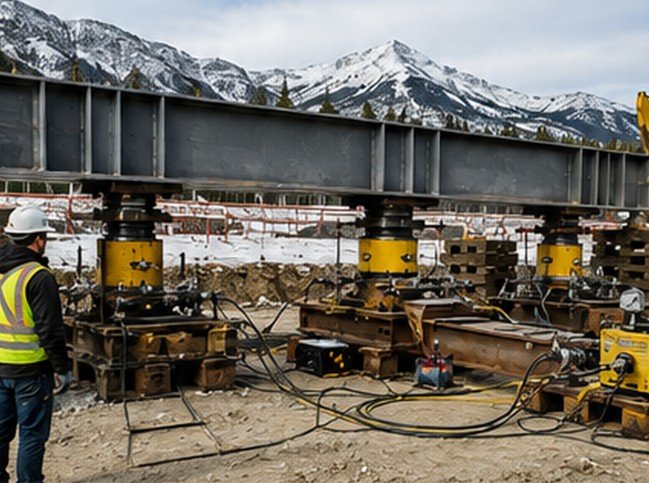
A modern hydraulic pile-load-test setup using a reaction structure, high-capacity jack and field instrumentation.
When you need to find out how much load a pile can actually support, eventually somebody has to apply that load.
And when that load gets into hundreds — or sometimes thousands — of tons, stacking a few concrete blocks on top and hoping for the best isn't really an option.
That's where hydraulics comes in.
Across Alberta, pile load testing is used on everything from commercial buildings and industrial facilities to bridges, transportation infrastructure, energy projects and other structures where serious loads have to be transferred safely into the ground.
The engineering behind these tests can become complicated.
The basic hydraulic principle isn't.
Apply a known force. Control it. Hold it. Measure what happens.
Simple idea.
Potentially enormous cylinder.
What Is a Static Pile Load Test?
A static pile load test physically applies a controlled load to a pile and measures how the pile responds.
For an axial compression test, the pile is pushed downward against a reaction structure while displacement is measured.
The relationship between applied load and pile movement gives the engineer information about the pile's performance and capacity.
In Alberta, static pile load testing is commonly performed in accordance with standards such as ASTM D1143/D1143M for deep foundations subjected to static axial compressive loads.
Depending on the project, testing may also involve axial tension or lateral loading.
Whatever the test configuration, one thing remains fairly consistent:
Something has to generate the force.
For conventional static testing, that something is usually a hydraulic cylinder or jack.
The Hydraulic Jack Is the Muscle
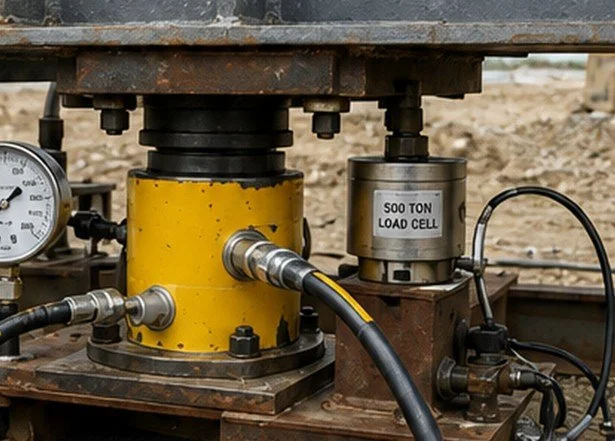
The hydraulic jack supplies controlled force while gauges and instrumentation monitor the test.
At the centre of most hydraulic pile load testing systems is a high-force hydraulic cylinder or jack.
The cylinder is positioned between the test pile and a reaction structure.
Hydraulic pressure is then increased in controlled stages.
The cylinder extends.
The reaction structure pushes back.
And the pile gets caught in the middle.
Which, conveniently, is exactly where we want it.
The force generated by a hydraulic cylinder is fundamentally related to two things:
Hydraulic pressure × effective piston area = force
That means very large forces can be produced using relatively compact equipment.
At 10,000 PSI, for example, a properly selected high-tonnage hydraulic cylinder can generate hundreds of tons of force without requiring a machine the size of a small building.
This is one of the reasons high-pressure hydraulics is so well suited to pile bearing capacity testing and pile compression testing.
What Equipment Is Needed for Pile Load Testing?
A hydraulic pile-testing system is considerably more than a cylinder connected to a pump.
A typical system may include:
High-tonnage hydraulic cylinder or jack
Hydraulic pump
High-pressure hydraulic hose
Pressure gauge or digital pressure instrumentation
Load cell
Control valves
Manifolds
Pressure-holding valves
Flow-control equipment
Displacement instrumentation
Data acquisition equipment
Reaction beams or reaction structure
Appropriate couplers, fittings and accessories
The exact configuration depends on the required test load, pile type, available space, reaction system, test procedure and instrumentation requirements.
And this is where equipment selection starts to matter.
Because a 100-ton test and a 1,000-ton test technically have the same objective.
They do not have the same shopping list.
Choosing the Right Hydraulic Cylinder
The first number everyone naturally looks at is tonnage.
If the required maximum test load is 500 tons, you obviously need equipment capable of safely producing the required force.
But tonnage is only the beginning.
Cylinder selection can also depend on:
Stroke. How much cylinder travel is required during the test?
Collapsed height. How much physical space exists between the pile and reaction structure?
Operating pressure. What pressure will be required to generate the desired force?
Return method. Is a single-acting cylinder adequate, or is powered hydraulic retraction desirable?
Load control. How precisely does the load need to be applied and maintained?
Physical configuration. Can the cylinder actually be positioned and properly aligned in the available space?
A cylinder that can theoretically produce enough force isn't necessarily the correct cylinder for the application.
Being able to lift 500 tons isn't particularly useful if the jack is six inches too tall to fit under the reaction beam.
General-Purpose High-Tonnage Cylinders
For many conventional static pile load tests, a single-acting high-tonnage cylinder provides a straightforward solution.
Hydraulic pressure extends the piston and applies the load.
When pressure is released, the cylinder returns through its designed return mechanism.
These cylinders are available in a wide range of capacities and strokes and are commonly used for heavy lifting, structural testing and foundation load-testing applications.
They are simple.
Reliable.
And capable of generating forces that make most shop equipment look fairly insignificant.
Low-Profile Cylinders
Pile-testing sites don't always provide generous working space.
Sometimes the distance between the top of the pile and the reaction structure is limited.
That's where low-profile or flat hydraulic cylinders become useful.
They can generate very high forces while maintaining a much shorter collapsed height.
The trade-off is generally shorter available stroke.
But when the alternative is rebuilding the reaction structure because your cylinder doesn't fit, short stroke suddenly seems like a pretty reasonable compromise.
Double-Acting Cylinders
For some tests, a double-acting hydraulic cylinder provides greater control.
Hydraulic pressure powers both extension and retraction.
That can make unloading and repositioning more controlled, particularly with large cylinders where relying solely on gravity or another return mechanism isn't ideal.
On sophisticated or high-capacity testing systems, controlled retraction can be an important consideration.
Because “eventually it'll come back down” isn't the kind of sentence engineers generally like seeing in a test procedure.
Hollow-Plunger Cylinders
Some testing arrangements require a rod, tendon, anchor or other component to pass through the centre of the cylinder.
That's where hollow-plunger hydraulic cylinders come in.
Their centre opening allows tensioning or loading arrangements that would be difficult or impossible with a conventional solid-plunger cylinder.
They are particularly useful when the geometry of the reaction or anchoring system requires the load path to pass directly through the hydraulic jack.
Selecting the Hydraulic Pump
Once you've selected the cylinder, you need something to power it.
For smaller tests or applications where speed isn't particularly important, a manual hydraulic pump may be perfectly adequate.
As cylinder size increases, however, manually pumping hundreds of cubic inches of oil becomes considerably less entertaining.
Larger systems generally benefit from an electric or air-powered hydraulic pump.
Pump selection should consider:
Required operating pressure
Cylinder oil capacity
Desired extension speed
Number of cylinders
Required control
Available electrical or compressed-air supply
Whether loads must be held for extended periods
Test environment and site conditions
A large high-tonnage cylinder connected to an undersized pump may eventually reach the required pressure.
You may also have enough time to reconsider several of your life choices while waiting for it.
Correct pump sizing makes the test substantially easier to control and considerably more efficient.
Pressure Isn't the Same Thing as Load
This is an important distinction.
A pressure gauge tells you the hydraulic pressure inside the system.
The engineer ultimately needs to know the force being applied to the pile.
Cylinder area can be used to establish the relationship between hydraulic pressure and theoretical cylinder force.
But accurate pile load testing requires more than reading a generic pressure gauge and doing some quick math.
The jack, gauge and associated instrumentation need to provide a reliable measurement of the actual applied load.
That's why calibration matters.
Calibration Matters — A Lot
Alberta specifications specifically recognize the importance of calibrated pile-testing equipment.
For example, provincial pile-testing requirements call for details of the hydraulic jacks, pumps and pressure gauges being used and certification of the calibration of the jack and pressure-gauge combination.
There's a good reason for that.
If the measurement system is inaccurate, the rest of the test data becomes questionable.
You can have an enormous cylinder.
A beautiful reaction frame.
Expensive instrumentation.
Three engineers watching it.
And a very impressive spreadsheet.
But if the actual applied load isn't known accurately, none of those things fix the underlying problem.
For serious load testing, calibration and traceability are part of the system — not optional accessories.
Load Cells Add Another Level of Measurement
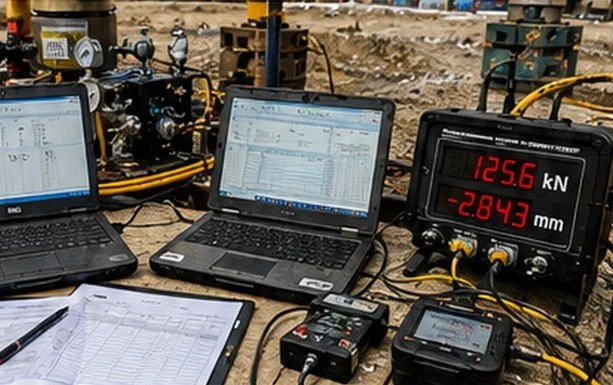
Field instrumentation and data acquisition can be used alongside hydraulic pressure measurement to document applied load and pile response.
Many modern pile-testing systems incorporate a load cell directly into the load path.
Rather than inferring force only from hydraulic pressure, the load cell measures applied force.
This can provide another level of accuracy and verification.
Load cells may be combined with:
Digital indicators
Data loggers
Pressure transducers
Displacement sensors
Computerized data-acquisition systems
Now we're considerably removed from:
“Pump it up until that gauge gets somewhere around 7,000 PSI.”
Which is probably a good thing.
Measuring Movement Is Just as Important
Applying the load is only half the test.
The other question is:
What did the pile do?
Static pile load testing measures displacement as load is applied.
Depending on the test arrangement, movement may be measured using dial gauges, electronic displacement sensors, survey equipment or other instrumentation.
The result is typically a relationship between load and displacement.
This allows the engineer to evaluate how the foundation responds as loading increases.
The hydraulic system therefore needs to do more than simply reach maximum pressure.
It needs to apply load smoothly and predictably, allowing meaningful measurements to be taken at each required stage.
Holding the Load
This is another area where hydraulic system design becomes important.
Many pile-testing procedures require loads to be applied incrementally and held while measurements are recorded.
The hydraulic system therefore needs to maintain the required force with minimal unwanted pressure loss or movement.
Depending on the system, this can involve appropriate:
Control valves
Check valves
Load-holding valves
Manifolds
Pressure controls
Pump controls
Anyone who works with high-pressure hydraulics knows that generating pressure is one thing.
Generating it, controlling it and keeping it exactly where you want it are three different things.
Multiple Cylinders and Synchronized Systems
Extremely high-capacity tests may require more than one hydraulic cylinder.
Multiple cylinders can be arranged beneath a common reaction structure to distribute load.
At that point, system design becomes considerably more important.
Flow distribution, pressure, cylinder movement and load balance all need to be considered.
Depending on the application, manifolds or more sophisticated synchronized hydraulic systems may be required.
When you're applying several thousand tons of combined force, “they should probably move about the same” isn't quite precise enough.
Alberta Conditions Add Their Own Challenges
Anyone who works construction in Alberta knows that equipment doesn't always get to operate in ideal laboratory conditions.
Pile load testing may happen:
In winter.
In mud.
In dust.
At remote industrial sites.
On transportation projects.
Around heavy equipment.
And occasionally at temperatures where hydraulic oil starts reconsidering whether it wants to be a liquid.
Cold temperatures affect hydraulic oil viscosity and system response.
Hoses, seals, pumps, gauges and instrumentation all need to be appropriate for the expected operating conditions.
Equipment selection for an Alberta pile load test therefore shouldn't consider only:
How much force do we need?
It should also consider:
Where are we doing this, and in what conditions?
Pile Load Testing in Edmonton
Edmonton has a long history of significant deep-foundation construction involving bridges, commercial development, transportation infrastructure and major industrial projects.
Full-scale pile load tests conducted in Edmonton have used hydraulic loading systems to test cast-in-place concrete piles in local soil conditions.
Some documented Edmonton tests have reached loads of several thousand kilonewtons.
That means pile load testing in Edmonton isn't merely a theoretical engineering exercise.
There are applications requiring genuinely serious hydraulic force.
And serious hydraulic force happens to be something Alberta industry knows reasonably well.
Pile Load Testing in Calgary
Calgary transportation and infrastructure specifications also recognize both static and dynamic pile testing.
For driven steel piles, City specifications can require test piles to undergo Pile Driving Analyzer (PDA) testing to determine pile load capacity.
Static testing remains another important method where direct physical loading is required.
That distinction matters.
Dynamic pile testing and PDA pile testing use instrumentation to evaluate pile response during impact.
A static pile load test physically applies a controlled load.
Different methods.
Different equipment.
Different information.
Helical and Screw Pile Load Testing
Not every pile being tested is a massive driven steel or cast-in-place concrete pile.
Helical pile load testing and screw pile load testing can also use hydraulic equipment to apply compression, tension or lateral loads.
The forces may be smaller than some major bridge-foundation tests, but the same fundamental requirements remain:
Apply a known load.
Control it.
Measure movement.
Document the result.
Hydraulics scales remarkably well.
The physics doesn't particularly care whether you're testing a relatively small helical pile or a foundation carrying part of a bridge.
Pier Load Testing
The same hydraulic principles can also be applied to pier load testing and other deep-foundation testing arrangements.
Reaction structures and equipment configurations may change, but controlled hydraulic force remains an extremely practical way of evaluating foundation performance.
For contractors and engineers working on bridges, commercial structures and heavy infrastructure, that means many of the same high-pressure hydraulic components can be configured for different testing requirements.
Static vs. Dynamic Pile Load Testing
These terms sometimes get grouped together, but they aren't interchangeable.
Static pile load testing applies a controlled physical load to the foundation and directly measures movement.
Dynamic pile testing measures the response of a pile subjected to an impact.
PDA pile testing is a form of high-strain dynamic testing using instrumentation to evaluate pile behaviour during driving or restrike.
Pile integrity testing generally evaluates the physical integrity or continuity of the pile rather than simply applying a large static test load.
Each has its place.
And some projects use more than one method.
Building the Hydraulic System Around the Test
There is no universal pile-testing hydraulic kit that is ideal for every project.
The correct system starts with the test requirements.
Before selecting equipment, you need to know things such as:
Maximum required test load
Test procedure
Pile type
Available reaction system
Available height
Required cylinder stroke
Number of cylinders
Required load accuracy
Required instrumentation
Available power source
Site conditions
From there, the hydraulic cylinder, pump, hoses, gauges, load cells, valves and controls can be selected as a complete system.
That's much better than starting with a cylinder somebody happens to have sitting in the shop and designing the entire test around it.
Although we're fairly certain that approach has been attempted.
Buying Versus Renting Pile-Testing Equipment
Pile load testing is also a good example of an application where hydraulic equipment rental can make sense.
A contractor may need a 200-ton cylinder regularly but require a 500-, 1,000- or even higher-tonnage system only occasionally.
Purchasing specialized equipment that spends most of its life sitting in storage may not be economical.
Rental can provide access to:
High-tonnage cylinders
Hydraulic pumps
High-pressure hoses
Gauges
Manifolds
Control equipment
Load-testing accessories
The important part is ensuring the equipment is correctly selected for the specific test.
Because renting the wrong 500-ton cylinder is still renting the wrong cylinder.
It's just temporarily wrong.
The Complete System Matters
The cylinder gets most of the attention because it's the component generating the enormous force.
But reliable hydraulic pile load testing depends on the entire system working together.
Cylinder.
Pump.
Hoses.
Fittings.
Valves.
Gauge.
Load cell.
Instrumentation.
Reaction structure.
Calibration.
And the people who understand how all of those pieces interact.
A hydraulic system capable of producing 1,000 tons of force deserves considerably more engineering attention than:
“Grab a pump and a couple hoses.”
The Bottom Line
Pile testing has become incredibly sophisticated.
Engineers now have static pile load testing, dynamic pile testing, PDA pile testing, pile integrity testing, helical pile load testing, pile compression testing, pile bearing capacity testing and numerous other methods available to evaluate deep foundations.
But whenever the objective is to physically apply a large, controlled static load, hydraulics remains one of the most practical ways to do it.
From relatively small helical pile tests to massive bridge and infrastructure foundations, the principle remains the same:
Generate the force.
Control the force.
Measure the force.
Measure the movement.
Know that the equipment doing all of it is properly selected and calibrated.
Because once you're applying hundreds or thousands of tons to something that's going to support a building, bridge or industrial structure, “close enough” really isn't a unit of measurement.
And as we like to say:
You ain’t strong. The oil is.