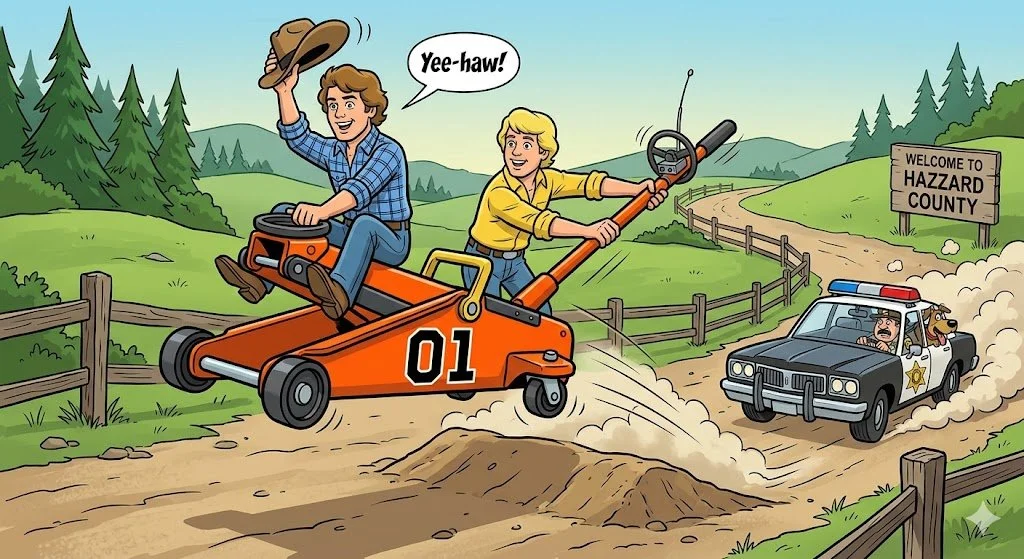
If The Dukes of Hazzard taught us anything, it’s this:
You can outrun Sheriff Rosco 🚓
You can jump a creek 🌉
But you cannot outrun a bad jack decision 😅
Picture it:
You’ve got a vehicle up on a floor jack…
Everything looks solid…
And then it starts dropping slower than Boss Hogg getting out of a chair.
🎶 “Just the good ol’ boys, never meanin’ no harm…”
Yeah… until the jack decides otherwise.
Or as they’d say in Hazzard County:
“Y’all might wanna rethink that.”
Floor Jacks: The General Lee of the Shop
Floor jacks get treated exactly like the General Lee:
Run hard
Pushed past their limits
Expected to perform every time
Rarely checked until something goes wrong
And just like those jumps…
“This might not end the way we planned.”
Every lift depends on one thing:
👉 Hydraulic pressure being fully contained inside the system
No pressure = no lift
Lost pressure = lost control
Because when pressure leaves the system…
so does your confidence.
How a Floor Jack Actually Works (Hazzard County Version — But With the Real Mechanics Behind It)
You’re not lifting the load directly…
You’re building and controlling hydraulic pressure.
And that pressure is doing all the work.
Or in simpler terms:
“You ain’t strong… the oil is.”
Step 1: The Pump (Where Pressure Starts)
Each pump stroke activates a small internal piston:
Draws oil from the reservoir
Pushes it through a one-way check valve
Forces it into the main cylinder
👉 Small volume… building pressure with every stroke.
Think of it like Bo flooring it before a jump:
not much at first… then suddenly you’re committed.
Step 2: The Pressure Build (Where Force Comes From)
Hydraulic oil does not compress.
So when it’s forced into a sealed cylinder:
Pressure increases
That pressure pushes the piston
👉 Because the lifting piston is larger than the pump piston:
You get force multiplication
Small effort → massive lifting force
“Now that’s what I call doing more with less.”
Step 3: The Lift (Geometry Matters More Than You Think)
The main ram extends and pushes the lifting arm upward.
👉 Floor jacks rely on leverage and angles, not just brute force.
That means:
Position matters
Load balance matters
Angle affects lifting performance
Bad positioning?
“Well… that didn’t go like we thought it would.”
Step 4: The Hold (Where Everything Must Seal Perfectly)
The system holds pressure using:
Check valves
Internal seals
👉 The jack is not mechanically holding the load…
It’s holding it hydraulically.
If anything leaks internally:
That’s your slow drop.
Or as Rosco might say:
“I think we got ourselves a situation here…”
Step 5: The Release (Controlled Pressure Loss)
Opening the valve allows oil to return to the reservoir.
Pressure drops
Load lowers
👉 Healthy system: smooth and controlled
👉 Worn system: unpredictable
“Easy now… easy… EASY—”
What Most People Don’t Realize
A floor jack doesn’t fail because it “breaks”…
It fails because:
Pressure can’t be built
Pressure can’t be held
Pressure can’t be controlled
👉 Every issue comes back to hydraulic integrity
Or in plain terms:
“If it ain’t sealed… it ain’t safe.”
Common Mistakes That Kill Floor Jacks (Faster Than a Bad Jump)
Overloading “Just This Once”
“Ah it’ll handle it.”
👉 That’s exactly how it starts.
Overloading damages seals
Warps components
Shortens lifespan
“That seemed like a good idea at the time.”
Side Loading (You Know You’ve Done It)
Using the jack off-center.
👉 Causes:
Frame stress
Uneven wear
Instability
Jacks are built for vertical loads only
“That ain’t how that’s supposed to work…”
Ignoring Oil Condition
Dirty oil = internal damage.
👉 Contaminated oil:
Wears seals
Damages valves
Reduces performance
It’s like running an engine with sludge.
“She’s runnin’… but she ain’t happy.”
Using It as a Jack Stand
👉 A jack is for lifting — not holding.
Leaving a load on it:
Increases failure risk
Wears seals faster
Is unsafe
“This is where things start going sideways…”
Dirty Shop Floors = Dirty Systems
Dust, debris, moisture — it all gets in eventually.
👉 And once it’s in…
It starts doing damage.
Ignoring Small Leaks
“That’s nothing.”
👉 That’s never nothing.
Small leak → pressure loss → failure
“You see that? That’s gonna be a problem.”
Air vs Manual Floor Jacks (Bo vs Luke Energy)
Air Hydraulic Floor Jacks
Fast
Less effort
Built for volume
👉 Weak point:
Dirty or wet air systems
“Fast is great… until it isn’t.”
Manual Floor Jacks
Simple
Reliable
Fewer components
👉 Trade-off:
More use = more wear
“Ain’t fancy… but it gets the job done.”
Why Floor Jacks Wear Out Faster
They:
Move constantly
Work in dirty environments
Get used heavily
Get pushed too far
👉 They’re in the middle of the action all day.
“That thing’s seen some stuff…”
Quick Floor Jack Check (Before It Goes Sideways)
✔ Oil leaks
✔ Smooth lifting
✔ Holds load steady
✔ Wheels and frame condition
✔ Oil level and condition
✔ Controlled release
👉 If something feels off — it is.
The Most Common Shop Mistake
“It still works.”
“Yeah… for now.”
The Rule of Hazzard County Mechanics
Just because it worked yesterday…
Doesn’t mean it will work today.
“Famous last words.”
Where Northland Air Hydraulics Comes In
At Northland Air Hydraulics Ltd., this is what we deal with every day.
We help with:
Diagnosing pressure loss and internal issues
Replacing seals and rebuilding components
Flushing contaminated systems
Repairing air hydraulic systems
Making sure equipment is safe and reliable
Whether it’s:
Floor jacks
Bottle jacks
Air hydraulic units
Or other lifting equipment
We help catch problems early — before they turn into failures.
Because let’s be honest…
It’s a lot cheaper than learning the hard way.
Let’s Keep It Simple
If your jack feels questionable… it probably is.
Bottom Line
Floor jacks are simple…
But they depend on:
Clean oil
Good seals
Proper pressure
Correct use
Ignore those…
…and things go from smooth to sideways real fast.
“And that’s when you wish you’d dealt with it sooner.”
Thank you,
Sam Callaghan
P.S. Gentle nudge: planned shutdowns are much less exciting when equipment maintenance is up to date.
NORTHLAND AIR HYDRAULICS LTD.
(780) 466-1172 | rnrldair@telus.net
7323 50 ST, EDMONTON, ALBERTA T6B2J9