
A surprising number of hydraulic setups are still run without proper pressure visibility or control. Honestly, at this point, more people have probably found Waldo than found the right gauge and valve setup on some pumps. They may work, but “working” and “working safely with 10,000 psi” are not the same thing.
Some jobs are simple. Some setups are straightforward. Some pumps are already doing exactly what they need to do without needing a whole hydraulic command centre bolted to them like it is preparing for takeoff.
But when the application does call for more control, better monitoring, or safer pressure handling, the right gauge and valve setup can make a massive difference.
It is kind of like putting a backup camera on a truck. Did people survive without it? Sure. Did they also back into a few things and pretend they “meant to park that close”? Absolutely.
A gauge and valve setup does not magically turn your pump into anything it is not. It just gives you more information and better control — which, in hydraulics, is usually the difference between “nice and smooth” and “why did that move like it was possessed by shop gremlins.”
And that matters because most Enerpac hydraulic pump systems are commonly designed around pressures up to 10,000 psi / 700 bar.
That is not “a little bit of pressure.”
That is serious pressure.
That is not “oops, I squeezed the ketchup bottle too hard” pressure.
That is the kind of pressure where guessing becomes a terrible life choice and “it should be fine” starts sounding like the opening line of an incident report. At 10,000 psi, you want to know what your system is doing — not just hope the pump woke up in a good mood and decided to be reasonable.
For a little perspective, uncontrolled 10,000 psi is not just “oops, that leaked.” It can damage seals, blow past weak fittings, whip a hose, move a load suddenly, or turn a tiny pinhole leak into a dangerous high-pressure stream. That is why you never check for hydraulic leaks with your hand. A leak that looks small can still be carrying enough pressure to cause serious injury.
Basically, 10,000 psi is not the pressure equivalent of a firm handshake.
It is more like a tiny angry dragon trying to escape through the weakest part of your setup.
And that dragon has tools.
That is why pressure needs to be monitored, controlled, increased gradually, and fully released before disconnecting anything.
The Gauge: The Little Round Truth Teller
A hydraulic gauge tells you what pressure your system is actually running at.
Not what it “feels like.”
Not what Dave thinks it probably is.
Not what your left eyebrow sensed when the cylinder started moving.
Actual pressure.
The gauge is the little round truth teller on your system. It does not care about confidence, vibes, shop folklore, or “we have always done it this way.” It just tells you what is happening.
And sometimes, that tiny little gauge is the only one in the room not lying to itself.
That matters because hydraulic systems depend on controlled force. Pressure builds force, force moves the load, and the gauge lets you see what is happening before things get dramatic.
Without a gauge, you may still be able to operate the system, but you are relying more on feel and experience. Sometimes that is fine. Other times, that is how a simple job turns into a group meeting beside a leaking fitting while everyone suddenly becomes a hydraulic detective.
A gauge can help with:
Monitoring pressure during operation
Avoiding unnecessary over-pressurizing
Repeating a process more consistently
Spotting changes in system behaviour
Giving operators more confidence instead of hydraulic jazz hands
Because “I think that is enough pressure” is not quite the same as actually knowing.
It is also not great when the system starts making noises that sound like it is clearing its throat before doing something expensive.
The Valve: The Bossy Little Traffic Director
If the gauge tells you what is happening, the valve helps control where things go and how they move.
A valve can control oil flow, hold pressure, direct pressure to the right port, or release pressure in a more controlled way depending on the setup.
Basically, the valve is the part saying:
“Oil goes here.”
“Not there.”
“Hold on a second.”
“Okay, now release.”
“No, not like a startled raccoon.”
“Everybody calm down, I am literally built for this.”
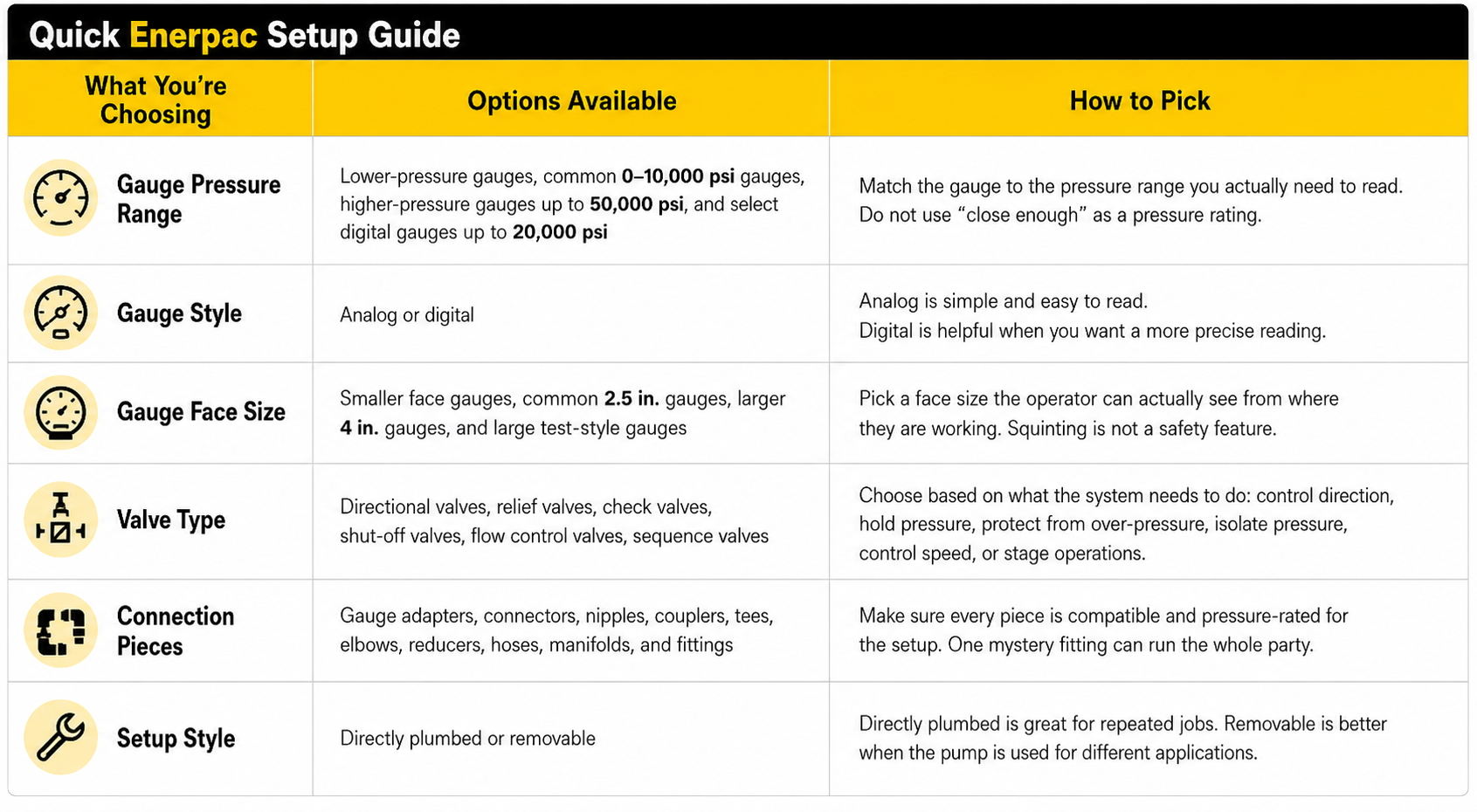
The correct valve setup depends on the pump, cylinder, tool, and job. Single-acting and double-acting systems do not behave the same way, and different applications may need different control options.
That is why “just slap a valve on it” is not the whole answer.
Hydraulics are powerful, but they are also very picky for something that mostly just pushes oil around. Like a toddler with 10,000 psi and a very specific snack order.
Use the wrong setup, and the system may still technically function — but so does a shopping cart with one bad wheel. You can use it, but everyone knows it is going to fight you the entire time.
Why the Right Combination Matters
A gauge by itself gives you information.
A valve by itself gives you control.
Together, when the application calls for it, they give you a better operating setup.
That can mean smoother movement, better pressure monitoring, safer pressure release, and less guessing. It also helps make the system easier to understand for the person using it.
And let us be honest — anything that makes a hydraulic setup easier to understand is already doing the Lord’s work.
Because once you have a pump, cylinder, couplers, fittings, adapters, oil flow, pressure, load weight, and someone saying “just lift it a little bit,” things can get spicy pretty fast.
And “just a little bit” is usually where the trouble starts.
It is never “just a little bit” when 10,000 psi gets invited to the meeting.
The right gauge and valve arrangement helps take the mystery out of the system. Instead of standing there squinting at the cylinder like it is going to explain itself, you have actual information and actual control.
That is a much better plan than staring at the equipment and hoping it respects your authority.
Directly Plumbed or Removable?
Some gauge and valve setups are built right into the pump or system. Others are made so they can be removed and used only when needed.
Neither is automatically better. It depends on the job.
A directly plumbed setup can be handy when the pump is often used for the same type of work and needs consistent monitoring or control.
A removable setup can be useful when you want flexibility, or when the same pump may be used for different applications.
It is kind of like choosing between a built-in cup holder and carrying your coffee around loose. One is cleaner. The other gives you options. Both can work. One just has a higher chance of ending with coffee on your pants and everyone pretending they did not see it happen.
A built-in setup may make sense when the pump has a regular job and you want the controls and pressure monitoring ready to go every time.
A removable setup may make sense when your pump gets used for different jobs and you do not want to permanently commit to one arrangement like it is a hydraulic marriage proposal.
The key is building the setup around how the pump is actually used — not how everyone hopes it will be used in a perfect world where fittings never go missing and nobody borrows the good adapter.
No, It Does Not Fix Everything
A gauge and valve setup can improve control and monitoring, but it does not replace safe operating practices.
You still need the right pump.
You still need the right cylinder or tool.
You still need properly rated hoses, couplers, and fittings.
You still need to know the load.
You still need to increase pressure gradually and release pressure fully before disconnecting anything.
A gauge and valve setup is a useful tool, not a magic wand.
If your system is being used incorrectly, adding a gauge will not suddenly make it responsible. It will just give you a front-row seat to the bad decision.
And at 10,000 psi, nobody needs front-row seats to a bad decision.
That is not a show anyone wants tickets for.
A gauge will not fix a damaged hose.
A valve will not make the wrong cylinder the right cylinder.
A nice-looking setup will not save a system from poor operation, underrated fittings, or someone saying, “I watched a guy do this once.”
Hydraulics reward proper setup and safe operation.
They do not reward confidence alone.
Confidence is great when ordering lunch. It is less great when you are standing beside a pressurized system making choices based on “probably.”
When Does It Make the Biggest Difference?
A gauge and valve setup is especially useful when you need better control, pressure awareness, or repeatability.
For example:
Testing applications
Controlled lifting
Pressing jobs
Holding pressure
Troubleshooting system behaviour
Applications where over-pressurizing could damage parts
Jobs where multiple people use the same equipment and consistency matters
In those situations, the setup can make the pump feel more predictable and easier to operate.
And predictable equipment is beautiful.
Predictable equipment does not surprise you.
Predictable equipment does not make everyone suddenly step backward.
Predictable equipment does not create the kind of silence where everyone stares at the same fitting.
You know that silence.
The one where nobody says anything for three full seconds because everyone is waiting to see if the equipment is finished having its little moment.
A proper gauge and valve setup helps reduce those moments.
It gives the operator better control, better visibility, and fewer reasons to make the face people make when they hear a noise they did not budget for.
The Big Takeaway
You would not run an air compressor without a gauge and just say, “Eh, it sounds about right.” So why do it with a hydraulic system? If air gets a gauge, your 10,000 psi hydraulic setup definitely deserves one too — because pressure should be measured, not guessed like the number of jellybeans in a jar..
But when the job calls for more control, better pressure monitoring, or safer operation, the right setup can make a serious difference.
A gauge lets you see what is happening.
A valve helps you control what is happening.
The right fittings and layout make sure it all works together properly.
It is not about making the system look fancier. It is about making it easier to operate, easier to understand, and safer to use.
Because in hydraulics, guessing is not a plan.
It is just confidence with no evidence.
And when you are working with pressures that can reach 10,000 psi, confidence is great — but control is better.
A good setup will not make the job do itself, but it can help keep the job smoother, safer, and a lot less dramatic.
And honestly, hydraulics already have enough pressure.
They do not need extra drama.
Thank you,
Sam Callaghan